🚀 Introduction: Where Geometry Meets Machine Learning
What if the secret behind powerful machine learning models wasn’t just code—but geometry?
The Hard-Margin Linear Classifier is one of the cleanest and most elegant ideas in machine learning. It shows how we can separate data perfectly using a line (or hyperplane) while maximizing confidence.
This concept is the foundation of Support Vector Machines (SVMs) and plays a crucial role in understanding how models generalize.
📐 What Is a Hard-Margin Linear Classifier?
A Hard-Margin Linear Classifier assumes that your data is perfectly linearly separable.
This means:
- You can draw a line (or hyperplane) that separates two classes
- No misclassifications are allowed
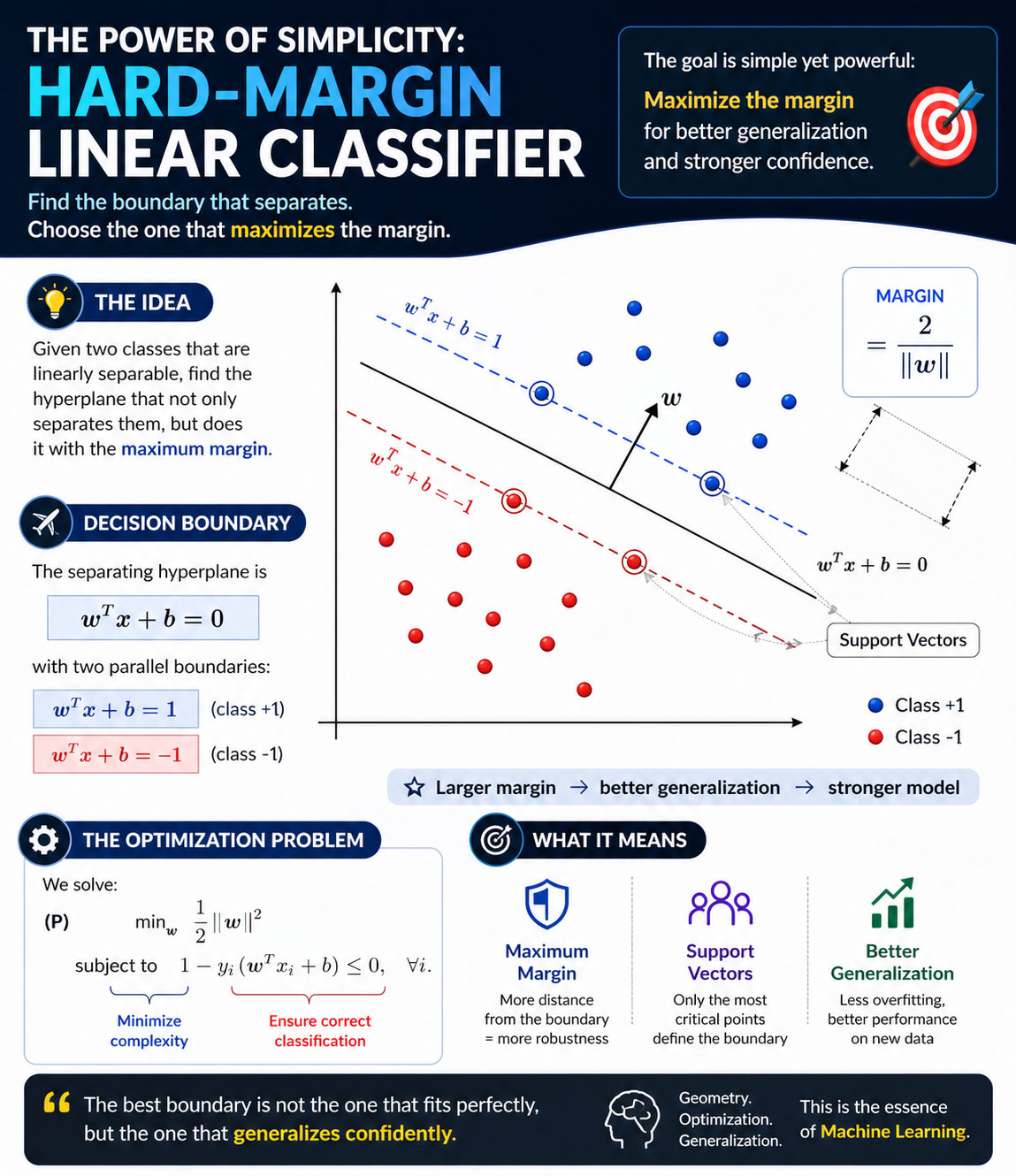
The decision boundary is defined as:
w^T x + b= 0
Where:
- w = weight vector
- b = bias
- x = input data
🎯 The Key Idea: Maximize the Margin
Not all separating lines are equal.
The goal is to choose the one that maximizes the margin, which is the distance between the two classes.
👉 The margin is:
margin = 2 / ∥w∥
💡 Insight:
- Smaller → Larger margin
- Larger margin → Better generalization
🔥 Why Maximizing Margin Matters
Maximizing the margin leads to:
- ✅ Better performance on unseen data
- ✅ More robust decision boundaries
- ✅ Reduced overfitting
In simple terms:
The model doesn’t just separate the data — it does it with confidence.
⭐ Support Vectors: The Most Important Data Points
Only a few points actually define the decision boundary.
These are called support vectors.
- They lie closest to the boundary
- They determine the margin
- Removing them changes the model
💡 Think of them as the critical structure of your dataset.
⚙️ Optimization Problem
The classifier is built by solving:
min_w (1/2 ∥w∥^2)
Subject to:
y_i(w^T x_i + b)≥1
This ensures:
- Correct classification
- Maximum margin
🎸 A Creative Perspective (Your Brand Voice)
As someone working at the intersection of machine learning, music, and geometry, I see this idea everywhere.
- In music → we separate noise from clarity
- In ML → we separate classes with confidence
- In life → we seek the most stable decisions
The Hard-Margin Classifier teaches us:
The best boundary is not the closest fit — it’s the one that generalizes best.
🔍 When Should You Use It?
Use Hard-Margin when:
- Data is perfectly separable
- You want a clean theoretical model
Avoid it when:
- Data has noise
- Classes overlap (use Soft Margin instead)
📈 Final Thoughts
The Hard-Margin Linear Classifier is more than a model.
It’s a reminder that:
- Simplicity can be powerful
- Geometry drives intelligence
- Optimization creates robustness