Understanding NumPy: The Foundation of Efficient Machine Learning and Geometry
In the world of Python programming, there is a clear “before” and “after” moment for every developer: the moment you discover NumPy.
If you are transitioning from theoretical mathematics into Machine Learning (ML) or Digital Signal Processing (DSP), you quickly realize that standard Python lists aren’t built for the heavy lifting of high-dimensional geometry. That is where the Numerical Python (NumPy) library becomes your most powerful tool.
Why NumPy is the De Facto Standard
Most developers know NumPy is fast, but few discuss why. At its core, NumPy allows the Python interpreter to communicate directly with compiled scientific libraries.
1. Memory Efficiency: The itemsize Advantage
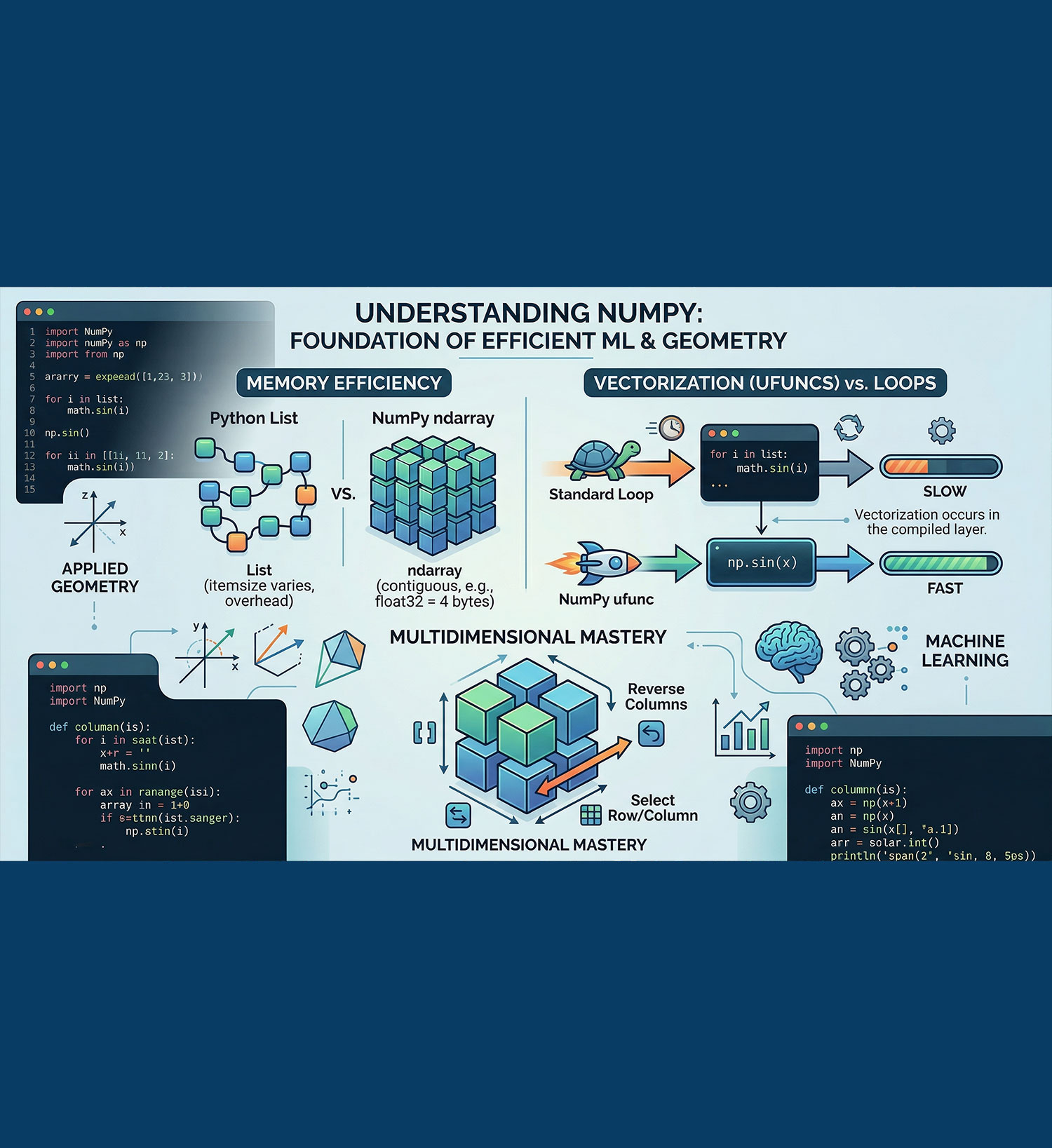
Unlike standard Python lists, which store pointers to objects, NumPy uses ndarrays—contiguous blocks of memory. By defining specific data types like np.float32, you can control exactly how many bytes each element occupies.
import numpy as np
x = np.array([1, 2, 3], dtype=np.float32)
print(x.itemsize) # Output: 4 bytes
2. The Power of Vectorization (ufuncs)
One of the biggest bottlenecks in Python is the for loop. When calculating the sine of a million points for a signal processing project, a loop is devastatingly slow. NumPy’s Universal Functions (ufuncs) perform operations element-wise in the compiled layer.
- The Manual Way: [sin(i) for i in list] (Slow, explicit looping)
- The NumPy Way: np.sin(x) (Blazing fast, vectorized)
Multidimensional Mastery: Slicing and Dicing Data
As an expert in Applied Geometry, I find NumPy’s handling of dimensions to be its most elegant feature. Whether you are working with a 2D matrix or a 32-dimension tensor, the slicing syntax remains consistent.
Common Slicing Patterns:
- Reverse Columns: x[:, ::-1]
- Select Every Other Element: x[:, ::2]
- Extract Specific Axes: x[0, :] (0th row) or x[:, 1] (1st column)
Why This Matters for AI and Machine Learning
In Machine Learning, we treat data as geometric objects in high-dimensional space. To perform transformations, rotations, or projections, you need a library that handles linear algebra with zero overhead. NumPy is the engine under the hood of TensorFlow, PyTorch, and Scikit-Learn.
Final Thoughts
If you’re building the next great AI model or analyzing complex geometric sets, mastering NumPy isn’t just an option—it’s a requirement. Stay tuned as I continue to share more insights into the intersection of Applied Geometry and Python Development.