What Is Statistical Learning? A Complete Beginner-Friendly Guide
Introduction
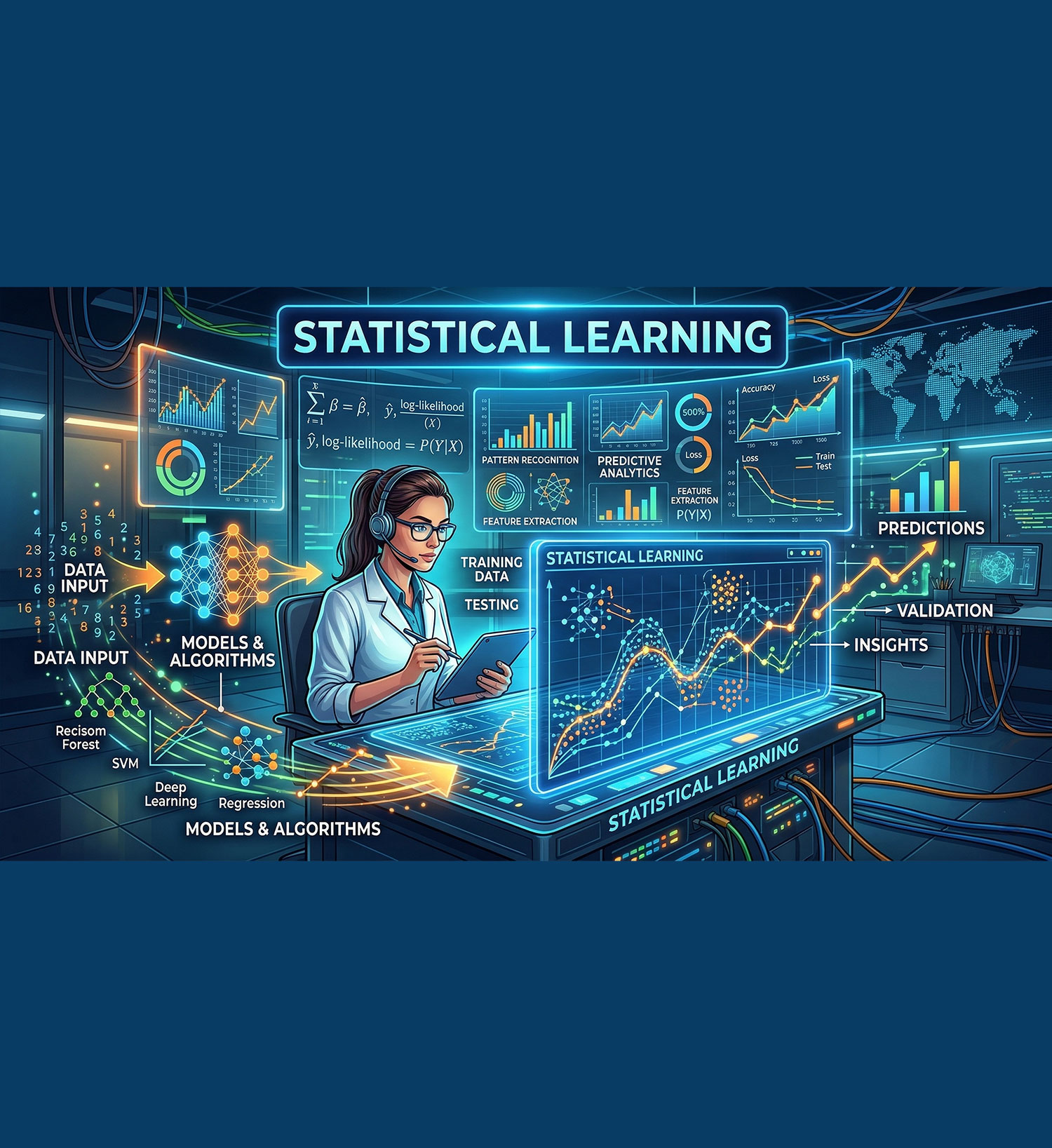
Statistical learning is one of the most important foundations of modern data science, machine learning, and artificial intelligence. It focuses on understanding and modeling the relationship between input variables and an output variable.
If you’ve ever built a predictive model, analyzed trends, or tried to make sense of data — you’ve already encountered statistical learning.
The Core Idea of Statistical Learning
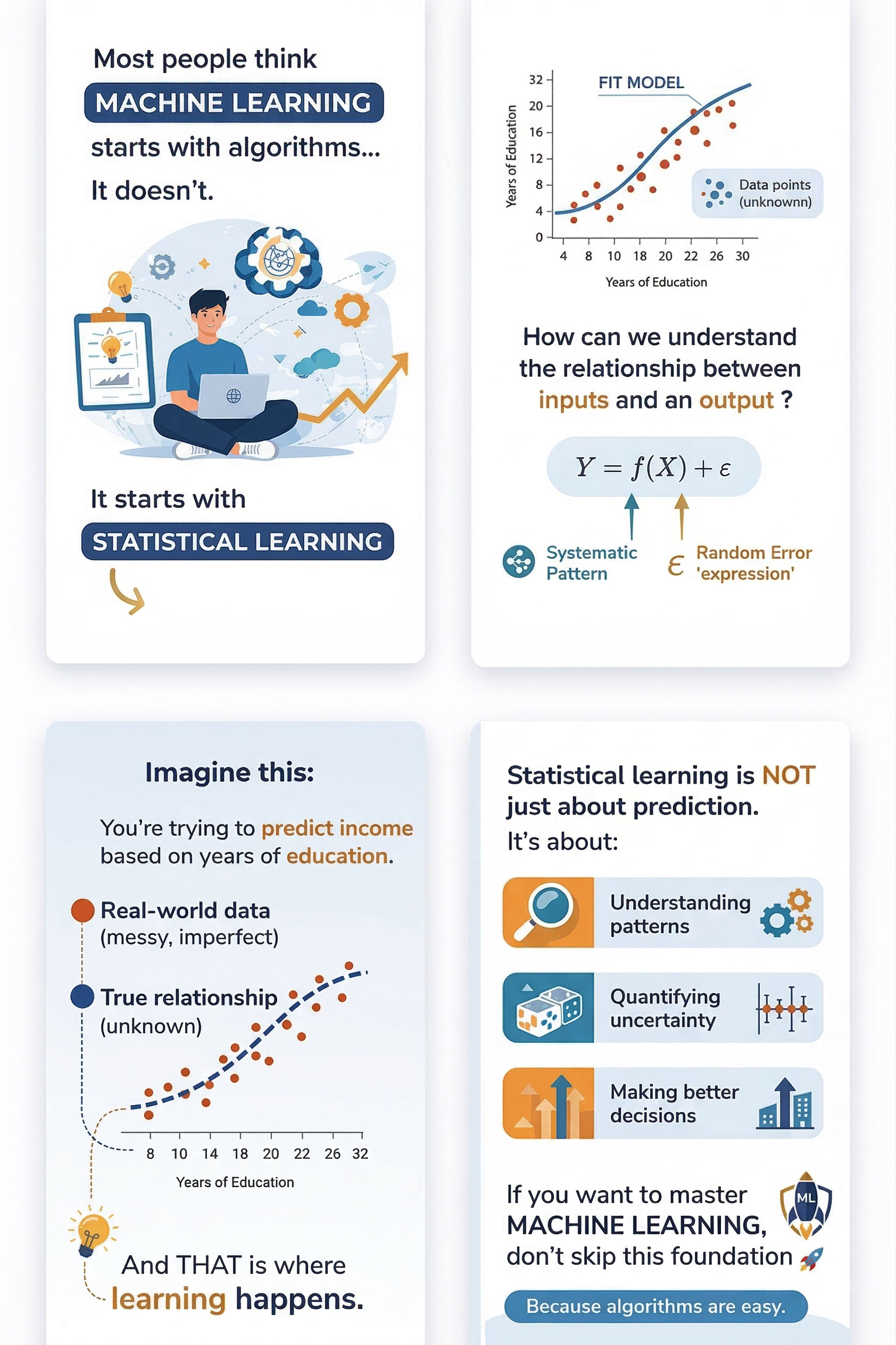
At the heart of statistical learning is a simple equation:
Y = f(X) + ε
Where:
- Y = output (response variable)
- X = input variables (features or predictors)
- f(X) = the true underlying function (unknown)
- ε (epsilon) = random error (noise)
The goal is to estimate f(X) using observed data.
Real-World Example
Imagine you want to predict a person’s income based on their years of education.
- The data points represent real observations
- The curve (f) represents the true relationship
- The difference between them represents error
Because real-world data is noisy, we never observe the true function directly — we estimate it.
Two Main Goals of Statistical Learning
1. Prediction
We use input variables to accurately predict an output.
Example:
- Predict house prices
- Forecast sales
- Estimate customer churn
2. Inference
We try to understand how inputs affect the output.
Example:
- Does education increase income?
- Which marketing channel impacts sales most?
Key Concepts in Statistical Learning
🔹 Input Variables (Features)
Also called predictors or independent variables (X₁, X₂, …, Xₚ)
🔹 Output Variable (Target)
Also called response or dependent variable (Y)
🔹 Error Term (ε)
Represents randomness, measurement errors, or unknown factors
🔹 Model
An approximation of the true function f(X)
Why Statistical Learning Matters
Statistical learning powers many real-world applications:
- Machine learning algorithms
- Recommendation systems
- Financial forecasting
- Healthcare predictions
- Marketing optimization
Without statistical learning, modern AI wouldn’t exist.
Conclusion
Statistical learning is about learning patterns from data in the presence of uncertainty.
It teaches us how to:
- Build predictive models
- Understand relationships
- Make data-driven decisions
If you’re serious about data science or AI, mastering statistical learning is not optional — it’s essential.
Final Thoughts
The next time you see a dataset, remember:
You’re not just looking at numbers.
You’re trying to uncover a hidden function behind them.
And that’s the essence of statistical learning.